

Nainital
Beauty, Bustle and the Ghost of the Raj

From my Journal
16 June 2006
The morning broke clear and luminous over Almora. The first rays of the sun filtered through the deodars and oaks surrounding the IB, gilding their leaves with liquid gold. A cool breeze drifted through the verandah carrying the scent of pine resin and damp earth, while somewhere in the valley below birds announced the arrival of another mountain day with its cheerful refrain. After a leisurely breakfast, we loaded our luggage into the car and began the drive towards Nainital.
The road wound through forests of oak, chir pine and rhododendron, occasionally opening onto breathtaking vistas where mountain ridges stretched endlessly into the haze, each more ethereal than the last. Villages clung improbably to steep slopes, their terraced fields resembling giant stairways carved into the mountainside. Women in colourful headscarves worked patiently in the fields while children waved enthusiastically as our car passed. Gradually the road grew busier. Cars bearing registration plates from Delhi, Haryana and Uttar Pradesh became increasingly common. Tourist buses lumbered uphill, motorcycles threaded their way through the traffic and roadside cafés started appearing. The transformation was subtle at first, then unmistakable. Quite suddenly, after one final bend, the mountains opened.
There, lying like an enormous emerald cradled in a ring of wooded hills, was Naini Lake. Even from a distance it possessed an almost hypnotic beauty. The morning sun scattered a thousand shards of silver across its tranquil surface while white clouds drifted lazily through its reflection. Houses climbed the surrounding slopes in graceful tiers, their colourful roofs peeping through forests of oak and pine. Above them rose the forested ridges embracing the lake as though protecting an ancient secret. It was an unforgettable first glimpse.
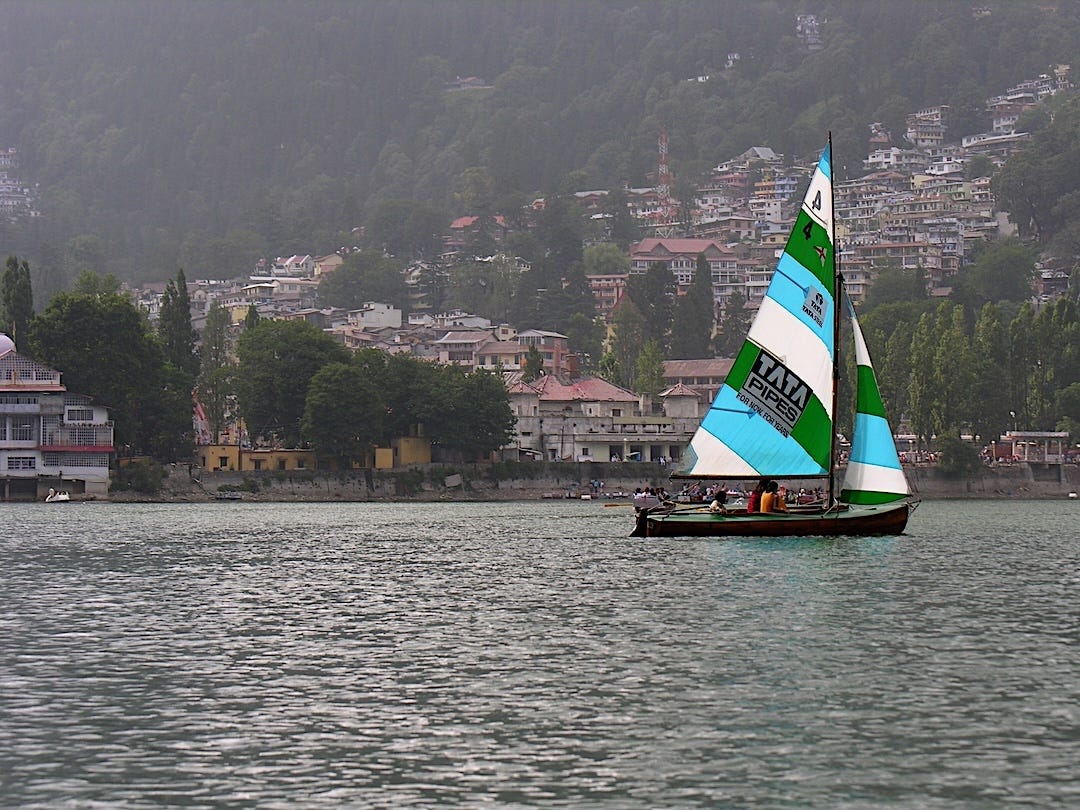
Nainital occupies a unique place in the history of Kumaon. Today it is one of India’s best-known hill stations, but during the British Raj it served as the summer capital of the United Provinces. As the furnace-like heat settled over the plains each April, government departments packed their files into wooden crates and an entire colonial administration slowly climbed into the Himalaya. For almost six months every year, governance itself shifted uphill. Lucknow surrendered its importance to this quiet mountain valley where governors, judges, civil servants and their families escaped the oppressive summer heat.
The British did not merely build a hill station. They recreated a fragment of England, suspended improbably among the Himalaya. Stone cottages with ivy-covered walls overlooked the lake. Flower gardens burst into colour each spring. Horse-drawn carriages rolled along tree-lined promenades where ladies carrying parasols strolled in the evening, while military bands played beneath the cool mountain sky. Yet beneath this carefully cultivated veneer of Victorian England lay a landscape infinitely older than empire. Long before surveyors measured these hills or colonial engineers laid roads around the lake, pilgrims had climbed these mountains to worship at one of Hinduism’s most sacred shrines. According to ancient tradition, Nainital is one of the fifty-one Shakti Peethas. When Goddess Sati immolated herself in grief after her father Daksha insulted her husband Shiva, the distraught Lord wandered the universe carrying her lifeless body. Fearing that his boundless sorrow would destroy creation itself, Lord Vishnu released his Sudarshan Chakra, gently dismembering Sati’s body so that Shiva’s anguish might finally subside. Her left eye, the naina, is believed to have fallen here. Where it touched the earth, a spring of celestial waters emerged, forming the emerald lake that became known as Naini Tal, the Lake of the Eye. History credits P. Barron with discovering the lake in 1839. Faith smiles quietly at the suggestion. How does one discover a place where pilgrims have offered prayers for centuries?
Perhaps Barron did not discover Nainital so much as introduce it to the British. Captivated by its beauty, he built the first house overlooking the lake and later described it as “an Eden hidden in the Himalayas.” Others soon followed. Within a few decades, forests gave way to cottages, churches, schools and elegant promenades, transforming an isolated mountain valley into the most fashionable hill station of northern India. The two stories, one historical and the other mythical, coexist without contradiction. One belongs to maps and archives. The other lives in faith. Standing beside the lake, both seem equally believable.
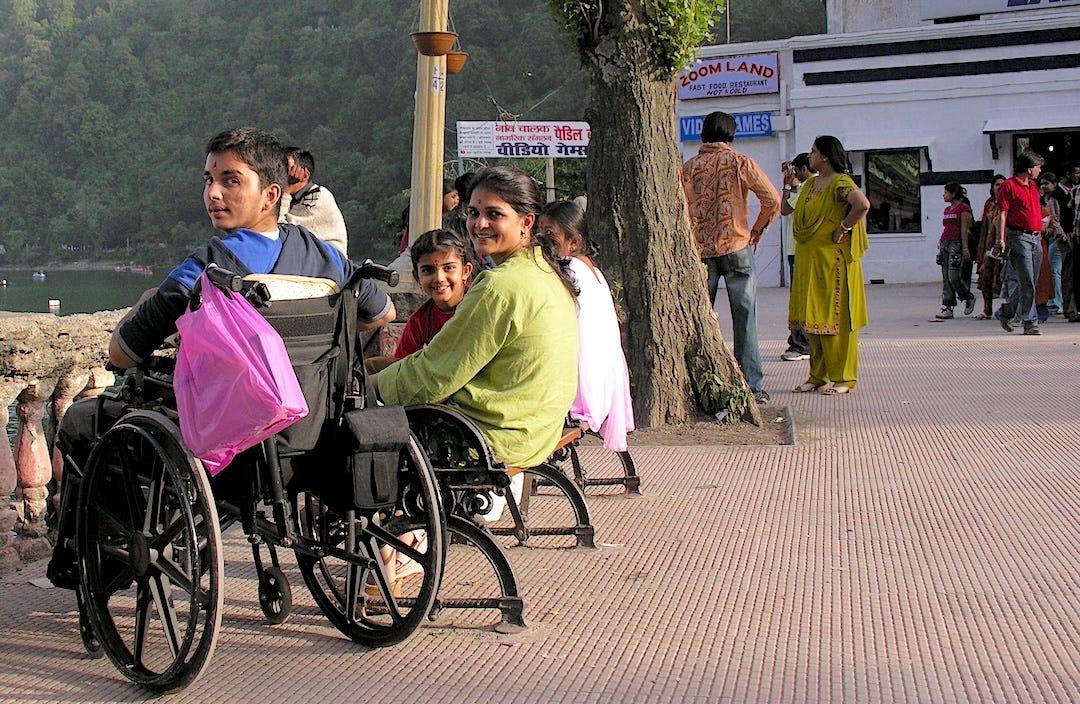
By the time we entered the town, however, another reality asserted itself. The serenity of the surrounding mountains yielded to the exuberance of a holiday crowd. If Almora possessed the quiet dignity of an old scholar, Nainital resembled a bustling carnival dressed in Himalayan clothes. Traffic crept bumper to bumper along the lakeside road. Cars, buses, motorcycles, taxis, rickshaws and handcarts competed for every available inch of space with remarkable determination and very little success. Horns echoed continuously from the surrounding hills. The pavements flowed with humanity. Yet one could not help reflecting that the silence one instinctively seeks in the Himalayas had retreated to some quieter valley. Nainital had become, as someone once aptly described it, an air-conditioned Karol Bagh!
Finding accommodation, however, proved considerably less charming. Every lakeside hotel displayed the same uncompromising notice: FULL. June, after all, is the season when much of northern India escapes to the hills. After what seemed an endless search, we eventually located a nice hotel whose greatest luxury was not only its rooms but the availability of a secure parking space. We unpacked our bags, looked out towards the lake shimmering beyond the rooftops, and silently agreed that one night in bustling Nainital would probably be enough. Outside, the emerald waters continued to sparkle beneath the late morning sun, patiently waiting for us to discover them from a rather quieter vantage point.
Naini Lake is not merely the geographical centre of the town. It is its heart, its memory and its soul. Everything in Nainital appears to turn instinctively towards the water. The roads trace its outline, the houses climb the surrounding hills in concentric tiers, and every visitor, sooner or later, finds himself standing beside its emerald waters, captivated by their quiet allure. The afternoon sun had mellowed into a gentle warmth. Rows of brightly painted rowing boats and sail boats rocked gently against the landing stage.
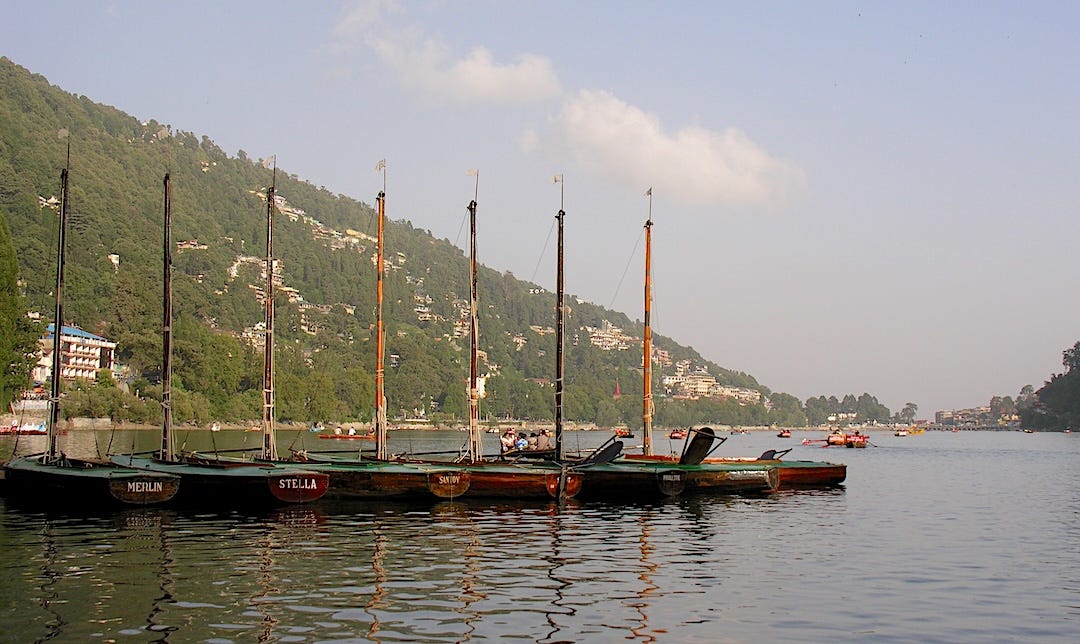
Their weathered boatmen waited patiently beneath colourful umbrellas, calling out cheerful invitations to prospective passengers. We chose one of the older wooden boats, its paint faded by years of mountain sunshine, and settled ourselves comfortably while our boatman pushed away from the jetty with a practised stroke of his oar. Almost immediately the world began to change. With every measured pull of the oars, the clamour of Mall Road receded behind us. The incessant horns softened into distant murmurs. Conversations became indistinct whispers carried away by the breeze. Even the crowds lining the promenade slowly dissolved into a tapestry of colours against the hills.
Water has a remarkable way of restoring perspective. Barely a hundred metres from the shore, Nainital once again resembled the peaceful mountain lake. The surrounding forests reclaimed their ancient dignity, and for a little while one could imagine the valley as it must have appeared before hotels, traffic and commerce claimed the shoreline. The boatman rested on his oars. Silence settled around us. The lake itself seemed to breathe.
Near the southern shore floated one of Nainital’s most delightful little landmarks, the famous duck house. From a distance it resembled a tiny lakeside cottage that had somehow drifted away from the shore. Resting upon a floating platform and painted in cheerful colours, it provided a secure refuge for the lake’s resident ducks. Throughout the day they wandered freely across the water, but as evening approached they returned faithfully to their floating home, as generations of ducks had done before them.
Below us another world unfolded. The water was astonishingly clear. Large carp drifted lazily beneath the boat, their bronze scales glowing softly in the filtered sunlight. Masher cruised with slow, effortless confidence through the deeper water, occasionally rising towards the surface before disappearing once more into the emerald depths. Whenever children scattered crumbs into the lake, the fish abandoned all dignity. Great swirling masses suddenly appeared beneath the surface, mouths opening eagerly as though the lake itself had begun to boil.
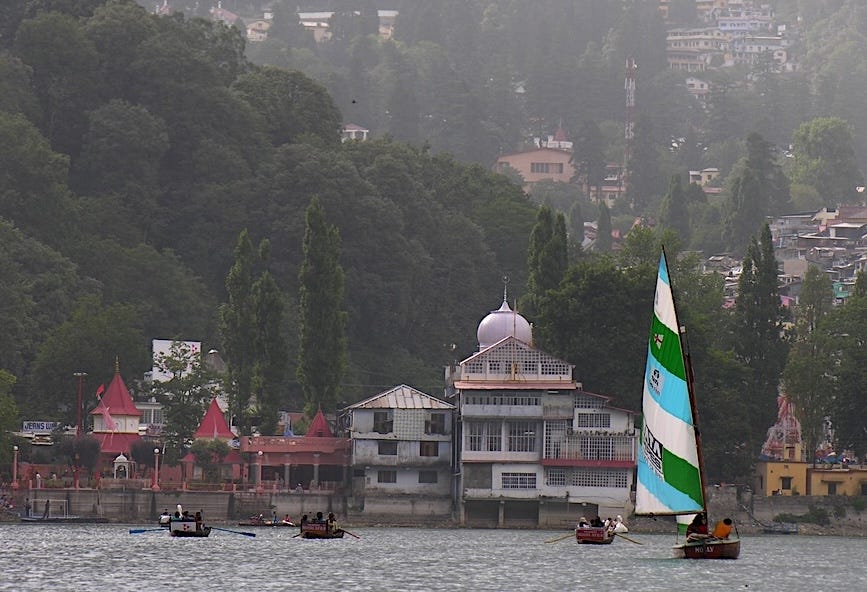
We lingered far longer than we had intended. There was no urgency. Eventually our boat touched the landing stage once more. From the jetty we wandered towards the Naina Devi Temple, where bells rang softly beneath fluttering crimson flags. The temple stands on the very site where, according to tradition, the eye of Goddess Sati fell to earth. Only a short walk away stood the Gurudwara. Its white walls gleamed in the afternoon light, offering the same welcome that Sikh shrines have extended to travellers for centuries. Listening to elderly devotees conversing effortlessly in Hindi, Punjabi and Kumaoni, I was reminded that communities, like rivers, gradually absorb the landscapes through which they flow. Faith may travel with migrants, but language quietly learns the accents of its adopted home.
For Abhi, however, Nainital was never merely about its lake. He had come in search of Jim Corbett. For years, Corbett had occupied a special corner of his imagination. Like countless readers before him, Abhi had first encountered Kumaon not through maps or travel brochures but through the pages of Man-Eaters of Kumaon, Jungle Lore and My India. Armed with curiosity rather than certainty, we wandered into Narain Book Shop, one of the oldest bookshops on Mall Road to enquire about Gurney House, Corbett’s beloved home overlooking the lake. The shop itself was a delight. Leather-bound classics rested beside modern paperbacks, while faded maps and old postcards recalled a bygone era. The elderly proprietor looked up over his spectacles with the easy smile of a man who had spent a lifetime among books. When we mentioned Jim Corbett, his face brightened immediately. “Yes,” he said with quiet pride. “Corbett Sahib used to come here.” The words were spoken without ceremony, almost casually, yet they transformed the shop around us. The proprietor pointed out several old editions of Corbett’s works and began recounting stories handed down through generations of booksellers. We left carrying rather more than we had intended. Our enthusiasm, however, received a gentle disappointment. Gurney House, we were informed, remained a private residence and was no longer open to visitors.
For a few moments Abhi looked visibly crestfallen. After travelling so far, it was natural to hope that one might stand upon the veranda where Corbett had written, gaze upon the same hills that inspired Jungle Lore, and perhaps imagine him setting out at dawn with Robin trotting faithfully at his heels. Instead we could only look towards the wooded slopes where the house lay hidden among the trees. Sometimes imagination must complete what travel cannot. Fortunately, the bookseller had better news. “If you truly wish to know Corbett,” he advised, “go to Kaladhungi.”
By now the afternoon sun had begun its slow descent behind the ridges, and hunger gently reminded us that even literary pilgrims require lunch. The recommendation of several locals led us to a delightful little restaurant called Mountain Magic, tucked away just enough to escape the constant bustle of the Mall. It proved to be one of those happy discoveries that travellers remember long after monuments have faded. The restaurant possessed an understated elegance. Wooden furniture, old photographs of Kumaon, shelves lined with books and large windows overlooking the hills created an atmosphere that encouraged lingering rather than hurried eating. The clientele reflected the spirit of the place. Young trekkers compared route maps over steaming bowls of soup. College students laughed over cups of coffee. Families rested after long walks, while solitary travellers sat quietly by the windows, notebooks open beside untouched mugs of tea. It felt less like a restaurant and more a mountain drawing room. The food was excellent. Good conversation, good food and mountain air have always formed a satisfying combination, and we lingered longer than we had intended.
Evening descended gently upon the lake. There was no sudden darkness, no dramatic flourish. The mountains simply began to gather shadows around themselves while the sky slowly softened from brilliant blue to pale amber, then to rose and finally to the deep indigo of approaching night. The restless crowds that had filled Mall Road throughout the afternoon were still there, but they seemed somehow quieter now. Near the floating duck house, the lake’s feathered residents were returning for the night. The lake was quietly putting itself to bed.